

Blog
Can We Make Jewellery Out of 24 Carat Gold?

The obsession of humans with gold jewellery is not new, and people have treated gold as the supreme metal for jewellery since time immemorial. When the era is compared, it is safe to say that the present time has only gotten more obsessed with gold, given how drastically its price is increasing. Modern-day people not only see gold as the finest material to make jewellery, but a way of investment and financial planning for the future.
One question that always pops up when choosing to make gold jewellery is, can we make jewellery out of 24 carat gold? Well, there are mixed answers to that because yes, you can make gold jewellery with 24 carat gold, but when it comes to other factors like wearing it on an everyday basis, then no! To understand what and when to make jewellery using 24 carat gold, you must understand the science behind it and the different carats available.
What is a Carat?
Before discovering if it is possible to make gold jewellery using 24 carat, let’s first understand the concept of carat altogether. The word carat refers to the finest of the gold and indicates the percentage of gold and alloy used. When talking about 24 carat gold, it means the purest form consisting of 99.9% gold metal, which is very soft and becomes hard to give any shape.
When alloy is mixed in the gold, the proportion of carat starts to change, and there are some common varieties of gold carat available in the market that determine its purity and are often preferred.
We will break down the commonly available gold carats, which are mostly used in making jewellery, and their cost also differs.
24 Carat Gold
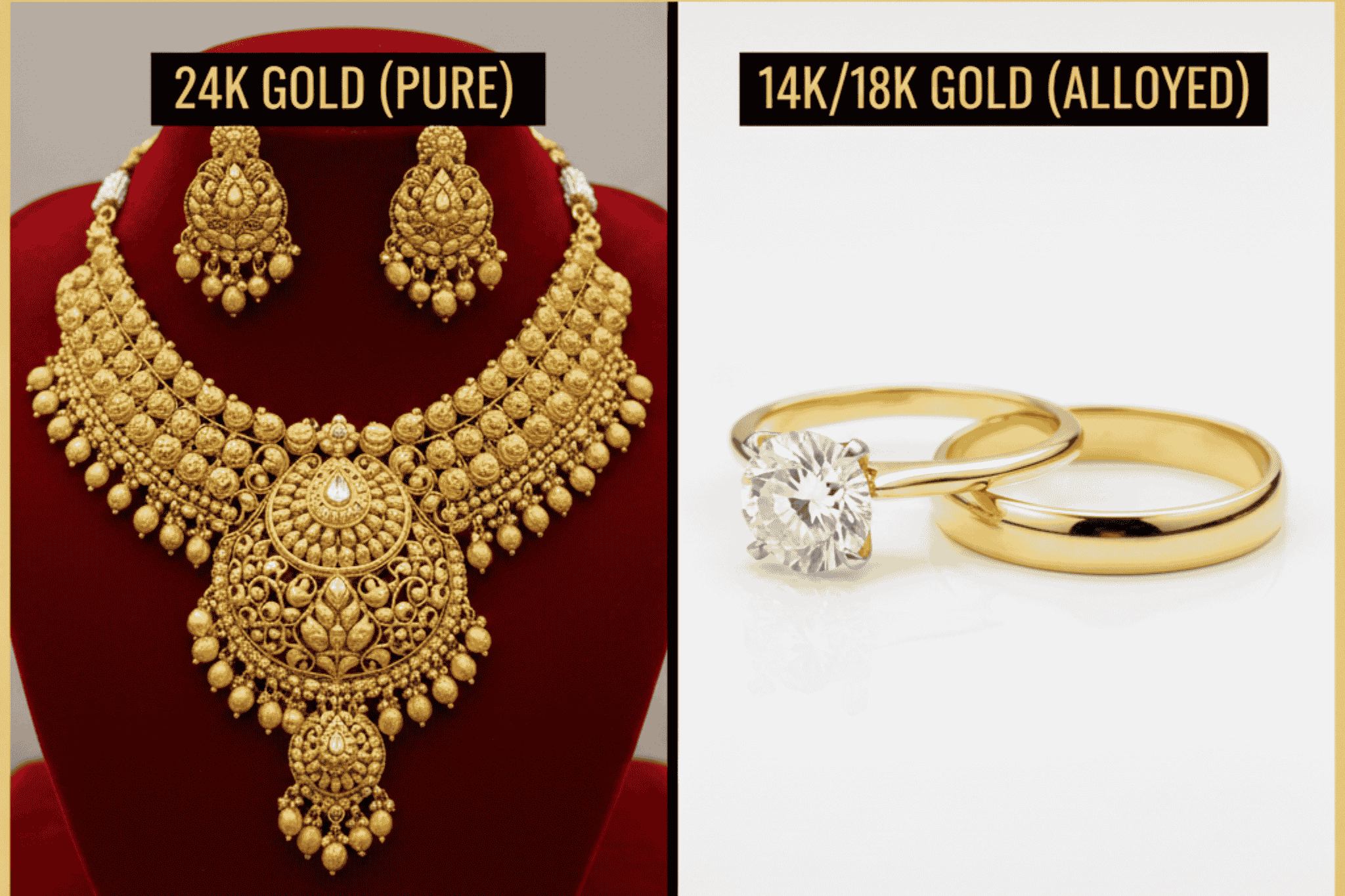
24 carat gold is the purest form of gold, consisting 99.9% of gold with a very minimal amount of other metals used. It is the highest quality of gold and is hardly used to make any jewellery because of its softness and difficulty in giving it any shape.
It is mostly used in gold coins and bars, and sometimes in certain electronic applications and medical equipment. 24-carat gold is often considered pure, but even to make gold coins and bars out of it, a tiny percentage of alloy is used.
22 Carat Gold
22 carat gold consists 91.67% of pure gold, with the rest of the percentage is generally made of silver or copper. It still makes for the highest carat and purity of gold and is known for its value. If you want to make gold jewellery using the highest quality material, then 22 carat gold is the ideal one.
By adding alloy, it is made durable and sturdy and becomes resistant to scratches. It is still soft and less malleable than other lower carat gold and may not be strong enough to hold stones and diamonds.
18 Carat Gold
18 carat gold consists of 75% gold and 25% of other metals, so it is like 18 parts of gold and 6 parts of other metals, generally made of copper, silver, and zinc. 18 carat gold is preferred because of its durability and still high hold content, which is ideal for everyday wear.
When compared to 24-carat or 22-carat gold, 18-carat gold is more resistant to scratches and can strongly hold diamonds and other gemstones, making it the preferred choice for engagement rings. The malleability is still high enough to have intricate designs and traditional jewellery with detailed engraving are often made on 18 carat gold.
16 Carat Gold
16 carat gold consists of 66.7% of gold and the rest of other metals, such as zinc, copper, and silver and is still considered in high value. It often makes a good choice when people are looking for gold jewellery that can withstand daily wear and tarnish, and come in a variety of designs.
The high level of malleability helps jewellers to make intricate designs on them, and they are made to last for a longer time. Because of their sturdiness, 16-carat gold is also used in making expensive watch cases and high-end decorative pieces and sculptures.
14 Carat Gold
14 carat gold has a purity of 58.3% and 41.7% of other metals like zinc, nickel, copper, and silver. It has 14 parts of gold and 10 parts of other metals and is generally less expensive than higher carat gold. The colour of the gold is also different and is mostly paler yellow due to less percentage of gold used.
The sturdiness it offers is higher and offers resistance to tarnish and wear. 14-carat gold jewellery also comes in a lot of designs because of its malleability and offers great strength to hold diamonds and gemstones. When looking to wear for everyday use, 14-carat gold is the best investment.
10 Carat Gold
10 carat is perhaps the lowest percentage of gold available in the market and has a purity level of 41.7% and the higher percentage consists of other metals like nickel, zinc, and silver. It is comparatively less precious and less expensive, but the chances of its getting tarnished are also higher.
The sturdiness of gold is high and resistant to scratches, and the shade of yellow is the palest. It is often used to make chains, rings, and simple earrings, but doesn’t offer intricate pieces. Also, you might develop skin irritation because of the majority use of other metals.
Why 24 Carat Gold is Not Suitable for Making Jewellery?
Despite being the purest form of gold, it is really difficult to make jewellery out of 24-carat gold. It is not like you won’t get jewellery made using 24 carat at all, it is just that the availability is rare, and there are plenty of reasons for it:
Extremely Soft
The malleability of 24-carat gold is a major concern area and this is why jewellery is not made of 24-carat gold because of its being extremely soft in texture. It is highly prone to bend and scratch, and may even break from places while you are still wearing them. The high malleability of 24-carat gold makes it almost next to impossible to retain its shape, and you may notice it getting out of shape within a few uses.
Easy Deformation
In relation to its high malleability property, 24-carat gold is prone to deformation, that too very easily. As it is pure in form and soft in texture, it can easily be bent during the process of engraving and giving it a shape. It may not even stand the test of time, and it is highly impractical to make jewellery out of 24-carat gold for everyday wear.
Difficult Polishing
Polishing gold jewellery is common, but when it comes to polished 24-carat jewellery, the task is not as smooth as other carats. Though 24-carat gold retains its natural shine, achieving perfect and even polishing is difficult, and the final results may look less shiny and often cause tiny scratches.
Benefits of Wearing 24 Carat Gold Jewellery
While it is rare to get 24 carat gold jewellery, it is still available, and despite having many downsides, the benefits too are plenty, which are discussed here:
Investment
As we have previously mentioned that 24 carat is the purest form of gold, and even if other metals are used, it is in the percentage of 0.1%, which makes it an ideal investment because the return value will always be equal or higher, depending on the current rate of gold.
Unmatched Shine
Gold is often compared to God’s metal and the qualities of the sun because of its unparalleled yellow shine. When talking about 24-carat gold jewellery, it gives you the unmatched yellow shine, which is often compromised with lesser carat jewellery because of the mixing of other metals.
Skin Friendly
Gold is known for its hypoallergenic properties, making it ideal for even those who develop allergies by wearing other metals. When mixed with alloy, the purity is compromised, and maybe their presence can develop allergies when you wear gold with a lower carat, but not 24 carat gold.
Factors to Consider When Buying 24 Carat Gold Jewellery
The less availability of 24-carat gold doesn’t make it less available, and jewellers still make jewellery out of it for certain statement pieces and traditional jewellery. If you are still interested in buying one, you must be careful with the quality and your purchase. Below are a few factors to consider when buying 24-carat gold jewellery:
Purity
The purity marks for the most important factor, and despite the shape and type you are buying, such as chains, bracelets, gold coins and bars, it must be 100% or maximum 99.9% pure.
You must check for the purity when buying 24 carat gold and ask if there is any alloy mixed, and if yes, then what is the percentage of it. Since the resale value of 24 carat gold is high due to its purity, do not ignore the factor at any cost.
Hallmark
Hallmarking has been introduced with the sole intention of maintaining transparency between the customers and sellers. Not just 24 carat, the hallmarking is important to check the purity of every carat. However, when it comes to 24-carat gold jewellery or coins, always check for BIS, a triangular logo showing that the item has been tested, and it also has an app through which you can check if the jewellery is original or not.
A fineness mark is another type of marking that declares the percentage of the gold, and for 24 carat, it will be 24K999. A Hallmark Unique Identification (HUID) Number is given to every single piece made with 24 carat gold to ensure authenticity.
Making Charges
You obviously can’t obtain gold in its raw form, and you will have to make a purchase through a jeweller and depending on the type, design, form and style of 24 carat gold, making charges are levied. If you are buying gold coins and bars, the making charges are generally less, but with jewellery, they are higher.
Also, keep in mind that 24 carat jewellery making charges are always higher than other carats because of the complexity of making a design and the softness that makes it harder for artists to give it a shape. If you don’t want to spend money on making charges, then go for gold coins or bars.
Human or Machine-Made Jewellery
Since making a design and giving raw gold a perfect shape takes a lot of time, machine made jewellery has been one of the breakthroughs in the world of jewellers. However, it doesn’t imply that you can’t buy human-made 24-carat jewellery.
The thing is, if you want to buy designs or jewellery for wearing purpose, then only choose for human-made jewellery, and if the purchase is just for investment purpose, then go for machine made. Both will also have different making charges as well, depending on the labour put in each of them.
Reliable Jeweller
The last factor is the most important one, which is to choose a reliable jeweller because the authenticity of the jewellery made out of 24 carat gold can only be guaranteed by a reliable jeweller. When you choose to purchase 24 carat gold in any form from a random jeweller, you are compromising with the quality, purity and even value.
These days, many fake jewellers even fake the hallmarking, which customers realize much later. It is always a good call to stay safe, to purchase from a brand and pay a little more on the making charges than compromising with the percentage of gold.
Final Words
24 carat jewellery is still in demand and more because of the purity. However, there are certain specifics involved when you think about can we make jewellery out of 24 carat gold, and if you find the right jeweller, you can definitely get one. Keep in mind the restrictions it comes with, like less possibility of intricate designs, no possibility of getting it studded with diamonds or gemstones, and others. When getting one, keep every factor in view and make your purchase based on your needs.
FAQs
Can you make jewelry out of 24K gold?
Yes, you can definitely get jewelry made out of 24K gold, but it is not suitable for everyday wear, is highly soft and prone to bent and tear.
Can we convert 24K gold to 22K gold?
Yes, we can convert 24K gold to 22K gold by mixing alloy to it, whether silver, copper, or zinc. Also, the purity level will come down from 100% to 91.67%.
Why is 24 carat gold not used for making jewellery?
24 carat gold is generally not used for making jewellery because of its softness and malleability, which makes it prone to scratches and bending, uneven polishing, and unable to hold gemstones and other stones.
What not to do with 24K gold?
When using 24K gold in jewellery form, do not use it for daily wear, do not use it for engagement rings, and do not use harsh material or chemicals on it.
What is the disadvantage of 24K gold?
The disadvantages of 24K gold are quite a few, including softness, making it prone to bend easily, prone to damages and scratches, limiting designs, not suitable for everyday wear, and risks of being lost.
Is there 22k gold jewelry?
Yes, 22k gold jewellery is available and those who want to invest in jewellery with highest purity next to 24 karat gold, 22k is ideal.
How to turn 24K gold into 14K?
To turn 24k gold into 14k, you will have to get it mixed with an alloy with a percentage of 41.7, and the purity level you get with 14k is about 58.3%.
Which karat gold is best for making jewellery?
22 karat gold is considered best for making jewellery if you want a high purity level, but designs at the same time, which is also strong. However, 18k or 14k gold is ideal when you want something to wear on a daily basis with diamonds and stones studded.