


Blog
Stainless Steel SS304 vs SS316: Differences & Uses

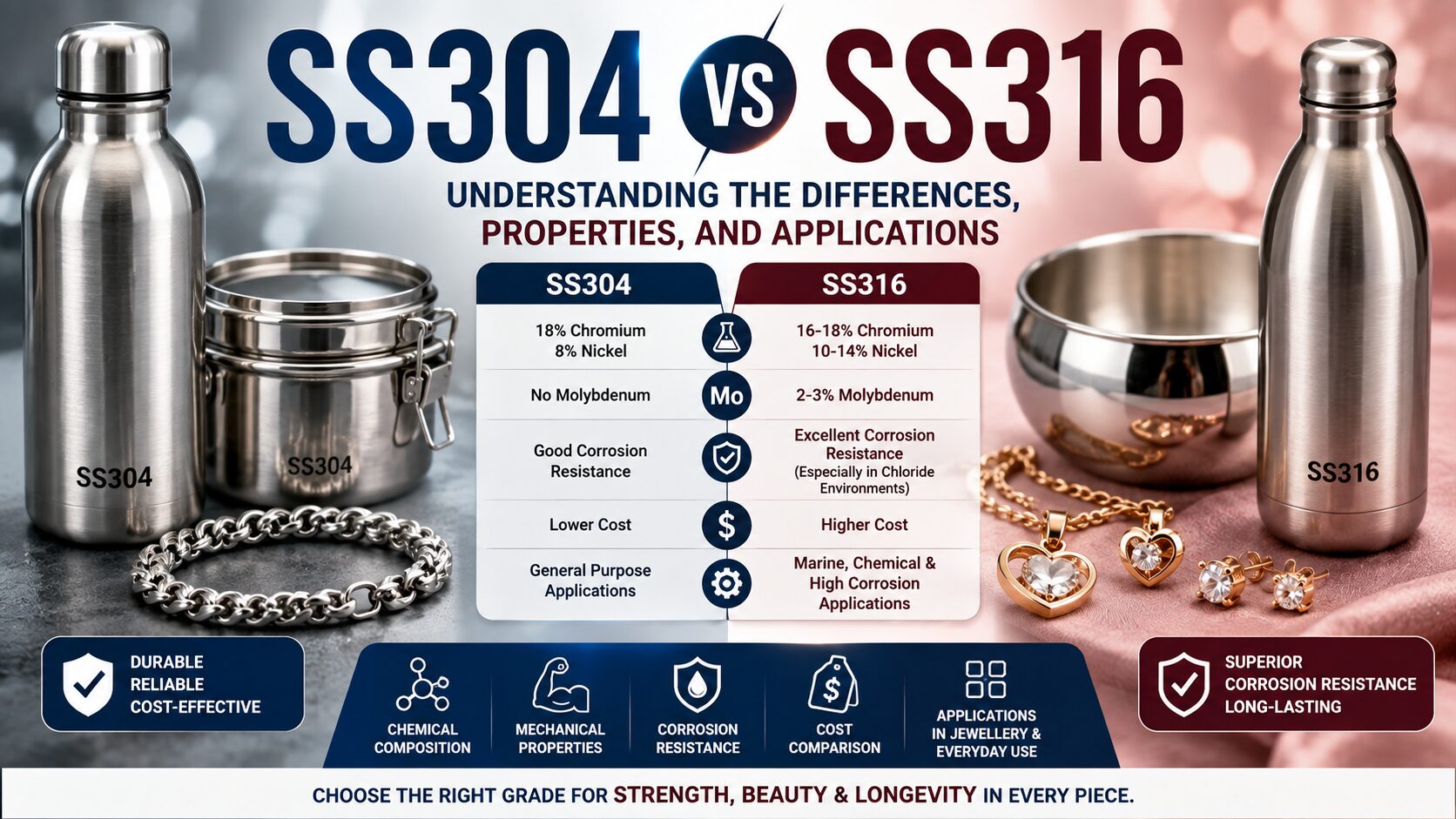
In various industries and construction, stainless steel is used as the leading material because of the properties it possesses, including great resistance, durability, less susceptibility to reaction, and aesthetic appeal, but not every type of stainless steel is suitable for every purpose because there are over 100 types, and making the right decision will be based mainly on the right selection of it. Among the 100 types that exist, SS304 and SS316 are the most prominent ones to be used, and the reason is simple: they excel in everything.
Though they both are known for similar properties, they vary from each other, and knowing these minor differences will become the basis of your decision. Since they are used primarily in a diverse range of industries from construction to medical equipment, kitchen utensils, artificial jewellery, and others, you will mostly choose one between these. However, considering the industry or application you intend, you can go for one of these, and that will be determined by understanding their core properties and major differences.
Today, we will discuss the major differences between SS304 vs SS316 and understand their strength, applications, and industries they are used in.
What is Stainless Steel?
Before diving into understanding anything about SS304 and SS316, let’s first understand what stainless steel is. Stainless steel is a material that contains a mixture of elements such as chromium, iron, nickel, etc. Chromium contains about 10.5% of the total weight and creates a protective oxide layer on the surface of the steel, making it a vital element. It prevents corrosion and increases resistance against several environmental factors, and it also has the ability to regenerate if damaged.
All these elements and metals make it withstand a challenging environment and offer long durability with minimal cleaning and less maintenance. Coming to 304 and 316, both are austenitic stainless steel types, ideal to be used in various industries because both of them have an increased tendency of durability and resistance. Since both of them still differ, let’s understand them individually.
What is SS304?
SS304 contains about 16 to 24% chromium, 35% nickel, and another percentage divided into other metals and elements, including manganese and carbon. This division of metals makes it an ideal choice for turning it into any shape and size and offers rust and corrosion resistance. Also, it is further divided into subcategories, but 18/8 stainless steel 304 is the most popular one because it contains 18% chromium and 8% nickel. However, choosing the type of ss304 depends mainly on the project and application.
What is SS316?
SS316 has similar properties to SS304, making it difficult to differentiate between the two because they even look the same. However, the major difference lies in the use of molybdenum in SS3016, which is present in about 2 to 3%. The presence of molybdenum makes SS316 offer resistance against chlorides and industrial solvents that can harm and affect materials when exposed to moisture or chemical compounds. There are also different types of ss316 stainless steel grade available that you can choose based on the project you are working on.
Major Differences Between SS04 and SS361
Now that you have a fair idea about the composition of both steels, let’s move on to understand the difference between ss304 and ss316 that we have discussed here:
Chemical Properties
Despite having the same physical appearance, the difference between 304 and 316 stainless steel is evident in their composition properties that we have discussed briefly above. Their chemical properties determine the industries and applications they can be used in. SS304 has higher chromium and lower nickel concentration, i.e., 18 to 20% of chromium and 8 to 10.5% of nickel, whereas SS316 has higher nickel concentration, about 10 to 14% and 16 to 18% chromium.
The higher nickel concentration makes SS316 superior for offering resistance against corrosion in saltwater and chloride environments. Another difference in the chemical properties is the presence of molybdenum in SS316, which offers higher strength and sturdiness, making it a preferred choice for the construction of marine applications or items that are likely to be exposed to an acidic environment.
Heat Resistance
When compared, SS316 has higher heat resistance and can withstand up to 870 Celsius, but SS304 can only withstand 800 Celsius, making the former an ideal choice for high-temperature environments, including refineries and chemical plants. This also establishes that despite being similar in physical appearance, both have different heat resistance.
The reason that SS316 has better heat resistance is because of the molybdenum material that makes overall pitting and crevice corrosion performance better than SS34. This also makes SS316 an ideal choice when equipment will be exposed to an environment rich in chloride ions.
Strength and Durability
SS316 has a higher tensile and yield strength and it is primarily because of the presence of molybdenum and higher nickel content though it doesn’t imply that SS304 is any less, and it also has enough strength for various industries and applications. The tensile strength of SS304 is between 500 and 700 MPa, elongation A50 mm of 45%, and hardness of 215 max HB, whereas SS316 contains 420 to 620 MPa, elongation A50 mm of 45%, and hardness of 149 max HB.
Anti-Tarnish
Though both SS304 and SS316 have good resistance to oxidation, tarnish, and corrosion, SS316 is a better choice, and this is why it is used widely in the making of anti-tarnish jewellery. Again, the presence of molybdenum offers resistance against sweat, salt, moisture, and other corrosive elements. SS304 is also used in the making of jewellery, but is more prone to change in appearance when exposed to harsh conditions and chloride-rich environments.
Corrosion Resistance
As briefly mentioned above, the presence of molybdenum in SS316 enhances its resistance to corrosion in chloride-ion environments, which is missing in SS304, but it still performs better in milder corrosive environments. For industries like coastal and marine, the SS316 grade is the best choice because it is 3 times better than what regular grade stainless steel offers against corrosion.
Price
The extra element present in SS316, which is molybdenum, makes it costlier than SS304, and it can also be used in critical industries such as medical, marine, and others. Another factor that makes it costlier than SS304 is the higher amount of nickel, making it withstand extreme and harsh weather conditions.
Application of SS304
SS304 is widely used in various industries and applications, but we are discussing some of the major ones here:
Kitchen Appliances
SS304 is the preferred material to be used in the making of kitchen appliances, countertops, sinks, cookware, and others because it offers excellent resistance to moisture and everyday corrosion. It is an ideal material for kitchens where appliances are frequently exposed to steam, water, oil, and others, and it is also easy to clean and requires less maintenance.
Automotive
The automotive industry uses SS304 for various applications such as decorative trims, heat shields, exhaust components, and others because of its strength, corrosion resistance, and ability to withstand higher temperatures. As it is also easy to mold and form into various shapes and sizes, manufacturers prefer SS304 and give it an amazing finish.
Food Processing Units
SS304 is a preferred choice in food processing industries such as dairies, beverages, bakeries, processing tanks, storage vessels, pumps, and basically everything that comes in direct contact with the food products. As it has a non-porous surface, it is easy to sanitize and clean, helping with maintaining hygiene, and also offers resistance against moisture and food-related substances.
Industrial Containers
For storage, manufacturers and production units often prefer SS304, and storage tanks, containers, hoppers, and vessels are made using the same. Its strength and corrosion resistance properties allow units to handle and store liquids with ease and without any deterioration. Since it is easy to weld into any shape, industries prefer to make any shape they want.
Architecture
SS304 is also used commonly in architectural and decorative applications and is majorly found in handrails, elevator interiors, doors, door and window fittings, and others. The reason being that it is easily welded and molded to make any shape and designs, along with giving an aesthetic and pleasing visual appeal required in modern architecture. It can also withstand environmental corrosion while maintaining its appearance over time.
Application of SS316
Now, let’s move to understanding the application of SS316 in diverse industries as we discuss below:
Marine Hardware
Considering its excellent resistance to chloride-rich environments, SS316 is used extensively in the marine industry for making hardware such as ships, boats, docks, and items that are continuously exposed to saltwater because they become prone to pitting and surface corrosion, and lower-grade stainless steel can’t offer the same. The presence of molybdenum makes it better for making railings, hinges, anchors, and other components.
Chemical Industry
The chemical processing industry uses S316 extensively because the equipment used in this may get exposed to aggressive chloride-containing substances, and it offers better resistance to pitting and crevice corrosion than SS304. It is commonly used in the making of pumps, valves, pipes, storage tanks, heat exchangers, and others.
Medical Instruments
For the making of various medical instruments, SS316 is a preferred choice, especially its low-carbon variant 316L. Since it offers resistance against corrosion, better durability, and can withstand frequent cleaning and sanitization, it is used to make medical equipment, orthopedic components, surgical instruments, trays, and others.
Food and Beverages
Though SS304 is used in the food and beverages industry extensively, SS316 is also used in the same but when it involves being exposed to acidic food, corrosive substances, salty ingredients, and brines. It offers enhanced resistance to chloride-related corrosion and becomes a better choice in comparison to SS304 and can also extend the life of the containers.
Pharmaceutical Industry
Not just medical, SS316 is also used in the pharmaceutical industry, such as processing and cleanroom equipment, where corrosion resistance, frequent sanitization, and cleaning are crucial. It is used in the making of storage tanks, fittings, mixing equipment, processing vessels, pipes, and others because its smooth surface can easily be polished regularly to offer protection against contamination and other residues.
Also see: What is Gold Sheet Jewellery? Features, Price & Value
Final Words
Despite being similar in physical properties and appearance, there are remarkable differences between SS304 vs SS316, and the decision should be based on what your needs are, depending on the industry you are working in or associated with. However, if we draw the differences based on everything discussed here, the conclusion will be that SS316 is a better choice in every aspect, but SS304 is also a great option if the use is not rigorous and cost is a factor.
FAQs
Which is better, 304 or 316L stainless steel?
Though both offer similar benefits and appearance, 316L stainless steel is a better choice because it contains molybdenum that makes it better in offering corrosion resistance, durability, and strength.
What is the strongest grade of stainless steel?
Grade 630, also known as grade 17-4 PH, is the precipitation-hardening grade and is considered the strongest grade of stainless steel.
How do I know if my stainless steel is 304 or 316?
To know if your stainless steel is 304 or 316, test it for molybdenum, and if it contains 2 to 3% of it, then it is 316, and if it tests negative for it, it is 304.
What is the cost difference between 304 and 316 stainless steel?
316 stainless steel is 10 to 30% higher than stainless steel 304 because of extra and higher chemical components.
Which is good, SS 304 or 316?
Generally, both are good, but SS316 is a better choice because it offers improved resistance against corrosion and chemical resistance.
What are the three grades of stainless steel?
The three grades of stainless steel are Grade 304, Grade 316, and Grade 430, and their use is determined by the industry.
For more such amazing articles, keep reading Laaddo.