

What is Polki Jewellery? A Complete Guide to its Origin & History

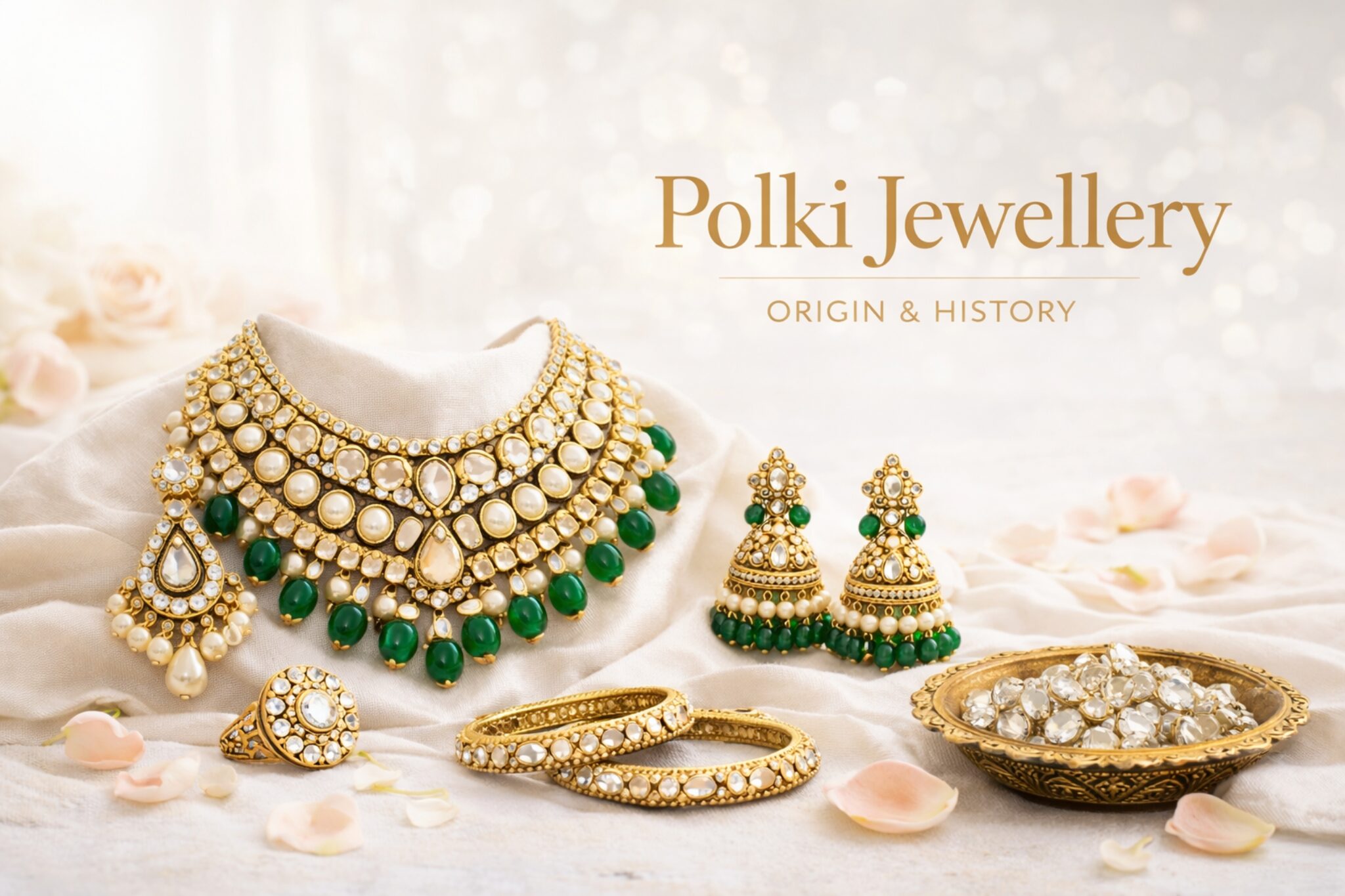
You might notice celebrities flaunting polki jewellery more frequently in recent times, and it does exude a royal aura, but it is not a new addition to the world of jewellery and has been in existence for centuries. It may have gotten into the limelight lately, but in certain regions, especially in royal families, polki jewellery has been a long-standing symbol of elegance, luxury, and tradition. This jewellery has also been passed on as a legacy because of its value and worth.
There is no denying that in the last decade, the popularity of polki jewellery has reached its peak, and it’s mainly because of how extensively celebrities are wearing it. It has drawn huge attention, and many women, including brides-to-be, are turning to polki jewellery and ditching typical gold and diamond jewellery. However, the majority of people are still unaware of what is polki jewellery, its origin, history, evolution, and art of making, but we will delve deeper into the details and explain everything related to it.
What is Polki Jewellery?
The beauty and uniqueness of the polki jewellery is that it is made with uncut diamonds and is kept in its raw and not polished form to retain its natural and organic look. The word “polki” is derived from the word “polka”, which means small, and it is considered one of the purest forms of diamonds. Its uniqueness gives it the elegance which is not found in other jewellery, and unlike traditional diamond jewellery, which is cut and polished to enhance the look, polki diamond stays in its raw form.
These uncut polkis are used in their original form to create intricate designs on a base made mostly of gold. Their original forms are not ever in even size, and that is why jewellery made using polkis instead of diamonds will always have different shapes and sizes. Since these are sourced originally and stay in their purest form, they are on the expensive side.
Origin and History of Polki Jewellery
The origin of polki jewellery goes back to the royal courts of Rajasthan, in the city of Jaipur, during the Mughal era. To date, the art of sourcing Polki and making it into jewellery remains intact, and Jaipur still dominates in its craftsmanship. However, polki was not originally found in India but was brought by the Mughals some 2500 years ago from the Indian subcontinent.
History suggests that Rajasthan became the centre of polki jewellery art because of the relationship between Jodha and Akbar, but it is a debatable topic. Since then, polki has been worn heavily amongst the royal families and was worn extensively mainly by queens and kings, making it a luxury ornament. The thing that matters is that polki has retained its value in the royal families of Rajasthan, even in today’s time, and its worth is getting appreciated more.
The Craft of Making Polki Jewellery
The most common question that strikes anyone who is thinking of buying it is how it is made, and the process behind it. Like any other original and traditional jewellery, even polki jewellery requires high-level skills and craftsmanship. Keep in mind that polkis are considered one of the raw forms of diamonds, but come in irregular shapes, giving them their unique appearance.
To make you understand the process, we are explaining it in steps:
Sourcing the Polkis
The first step is to source the polkis as they are expensive and come in a raw form, and before using them to make jewellery, artisans first confirm their quality, genuineness, shape, and clarity.
The Base
Unlike with other diamonds or precious stones, the base made for polki jewellery is designed once the polki is sourced. It is because polki diamonds don’t come in a regular or uniform shape, but each of them is uneven. The base is designed after getting certain with the shape of each polki being used in the jewellery. The base is made of gold.
Jadau Settings
Polki jewellery gets its distinctive definition from its jadau settings, in which the diamonds are placed into the base. After the polki diamonds are put in the base, melted gold is poured to set and secure the jewellery, which makes it very strong and lets the polkis shine in their natural form. To solidify the diamonds, a natural glue, “lac,” is used to fill the gaps. Lastly, meenakari enamelling is used to decorate the jewellery to give it a royal look and adds depth and meaning to it.
Types of Polki Diamonds
Even though they come in an uncut shape, polki diamonds also have different types. We are discussing 3 main types of polki diamonds, though there are more types available, which are the recent additions.
Kilwas Polki Diamonds
Kilwas polki diamonds have a flat bottom and a dome-shaped top and usually come in bright and white colours. They are thin and may have some impurities like black spots and blurry lines. They are famous for their simplicity and are a little on the inexpensive side. You will see them used mainly in the contemporary polki jewellery designs, and they are further divided into two types. Filling Kilwas Polki is coated with a chemical to hide its impurities, and may wear off in a couple of years, and non-filling Kilwas Polki, which has no chemical filling and stays in its natural form with its impurities and dark spots.
Syndicate Polki Diamonds
Very much like the features of Kilwas Polki Diamonds, Syndicate Polki Diamonds also have a flat bottom and faceted dome-shaped top. However, it is used in its raw form to make the jewellery and retains its natural shape and surface, giving it a bright look. They are thick and may have little chemical filling, but are high in quality. They are mainly used in the making of premium and luxury sets, and their value often increases because of their clarity and natural form.
Zimbabwe Polki Diamonds
Zimbabwe Polki Diamonds are the rarest type, which also makes them the most expensive ones, and it is due to their natural appearance and long-lasting feature. As the common features of the polki diamonds, even these polkis have a flat bottom and a faceted, dome-shaped top surface. Its form is retained naturally, and not even a bit of chemical filling is done to craft the jewellery using it. Perhaps all the royal polki jewellery was made using this one.
Features of the Pure Polki Diamonds
Like diamonds, gold, and other semi-precious stones, even polki diamonds have certain criteria to prove their authenticity and pureness. If you are looking to buy one, here are some points you should keep in mind:
Colour
The colour of the polki diamond is the most important factor, and as polki diamonds are sourced naturally and stay in their natural form even during the making process, the colours are not as bright as the diamond, but a little yellow. The polishing is done in the later stage to achieve shine, but when you buy them, you see them in their raw form.
Clarity
Unlike other diamonds, the pureness of polki diamonds is not based on the carat but on the clarity. The clarity of the polki diamonds is determined by the inclusion rate, and the lower the better. If the polkis don’t contain any inclusion, it is the most preferred one.
Treatment
Though for the most part, the polki diamonds stay raw and in their natural form, sometimes they too are treated to attain a certain level of shine if the black spots and the colours are too evident. However, highly treated polki diamonds lose their worth and are often less expensive than the ones that are not treated at all. To treat them, chemical filling is used, and khilwas polkis are treated mostly because of the inclusion rate and yellowish colour.
Shape
One thing that makes polki diamonds distinctive from the rest of the diamonds is their uneven shape. While other diamonds are crafted and heavily treated to achieve a fine shape, polki diamonds stay in their original shape, which is mostly uneven. The only treatment is done to them to fix their colour gradation. If you are buying polki jewellery and witness all of the stones in the same even shape, know for a matter that they are not original.
How Polki Jewellery Differs from Kundan Jewellery?
People often get confused between polki and kundan jewellery due to their similar appearance, but they differ a lot, right from the materials used to the craftsmanship. Both are loved, but when looking to buy specifically polki jewellery, knowing how they differ from kundan jewellery is very important.
Here are some of the major differences between polki and kundan jewellery:
Material
Polki diamonds are often considered the purest form of diamonds, and polki jewellery is made using the natural and uncut form of polki diamonds. They are not polished or cut to achieve a conventional look, and their unevenness is one of their distinctive features. The authenticity of the polki stones makes them luxurious and expensive.
Kundan jewellery, on the other hand, uses glass stones in the making, which are polished and cut to achieve the look of real diamonds or precious gems. They are obviously way too cheap compared to the polki jewellery and are embedded into a gold or gold-plated base, and look bright and shiny.
Price
Price is also one of the important factors to consider when comparing polki and kundan jewellery, and the difference is quite evident. Polki jewellery is a premium and a luxury product, despite you purchasing the polki diamonds that are treated with chemical filling. The jewellery is made using real diamonds and is often made in gold as a base, adding to its price, and the return value is also good.
Kundan uses glass materials, which obviously can’t match the price of polki jewellery. The base, too, is not strictly of gold, and the glass stones are often fixed in the gold-plated bases, making it a budget-friendly option. Kundan jewellery is preferred by those who want to have some regal pieces to wear temporarily, but without investing a fortune.
Crafting
Both kundan and polki jewellery require skilled craftsmanship to make, but their techniques differ. In the making of the polki jewellery, the diamonds are directly set into the gold base and using the melted gold, the diamonds are affixed. To ensure that the diamonds are stuck properly, a little bit of glue ‘lac’ is used. The process is also time-consuming, and that adds to the value of the jewellery.
To make kundan jewellery, lac is used extensively to stick it to the base, which is often of gold foil or plated. The glass stones, which are the mark of the kundan jewellery, are then secured to the gold foil base. It is comparatively an easy and faster process than polki jewellery.
Final Words
Polki jewellery might be getting a lot of limelight in recent times because of its constant appearance, but it has existed in the country for more than 2500 years. Their rarity and raw shape and form make it one of the most precious categories of diamonds, and if you are thinking of investing in something more precious than a real diamond, you may find your suitable match in polki jewellery. Before purchasing them, polish your knowledge regarding what polki jewellery is and how they differ from the rest of the diamonds.
FAQs
Is Polki a real diamond?
Yes, polki is considered a real diamond and one of the purest forms of diamonds because it is not treated or polished and used in its raw form to make jewellery.
Is it worth buying Polki jewellery?
Yes, investing in polki jewellery is worth the same as investing in other diamonds. Instead, it is more expensive because of its rarity and the lack of lab treatment. The return value is also good.
Which is better, Polki or Kundan?
If you want to invest in real diamonds that hold some value, then real polki jewellery is an ideal option. However, if you are looking for a cheaper and temporary option, then go for kundan.
How can you identify real polki?
Polki jewellery is easily identifiable as it is not as shiny and bright as the other diamonds, and each piece used in the jewellery is uneven in shape and size.
What is the price of a 1-carat Polki diamond?
As there are different types of polki diamonds available, including Kilwas Polki Diamonds, Syndicate Polki Diamonds, and Zimbabwe Polki Diamonds, the price of 1 carat will differ based on the purity level.
What is a poor man’s diamond?
A poor man’s diamond refers to the semi-precious stones which are affordable and copy real diamonds. The most common examples of such stones are moissanite, zircon, and aquamarine.